
Industrial Solar Installation in Indore: Benefits, Cost & ROI for Industries
As electricity costs continue to be an important operating expense for factories, warehouses, manufacturing units and other industrial businesses, Industrial Solar installation in indore is becoming an increasingly attractive way to manage long-term energy costs.
Indore has a growing industrial and commercial ecosystem. Businesses with significant daytime electricity consumption can benefit from well-designed rooftop or ground-mounted solar systems. The right system can help reduce dependence on grid electricity, improve energy cost predictability, and support a company’s sustainability goals.
If you are planning industrial solar installation in Indore, understand the benefits, project cost, installation process, and expected return on investment before making a decision.
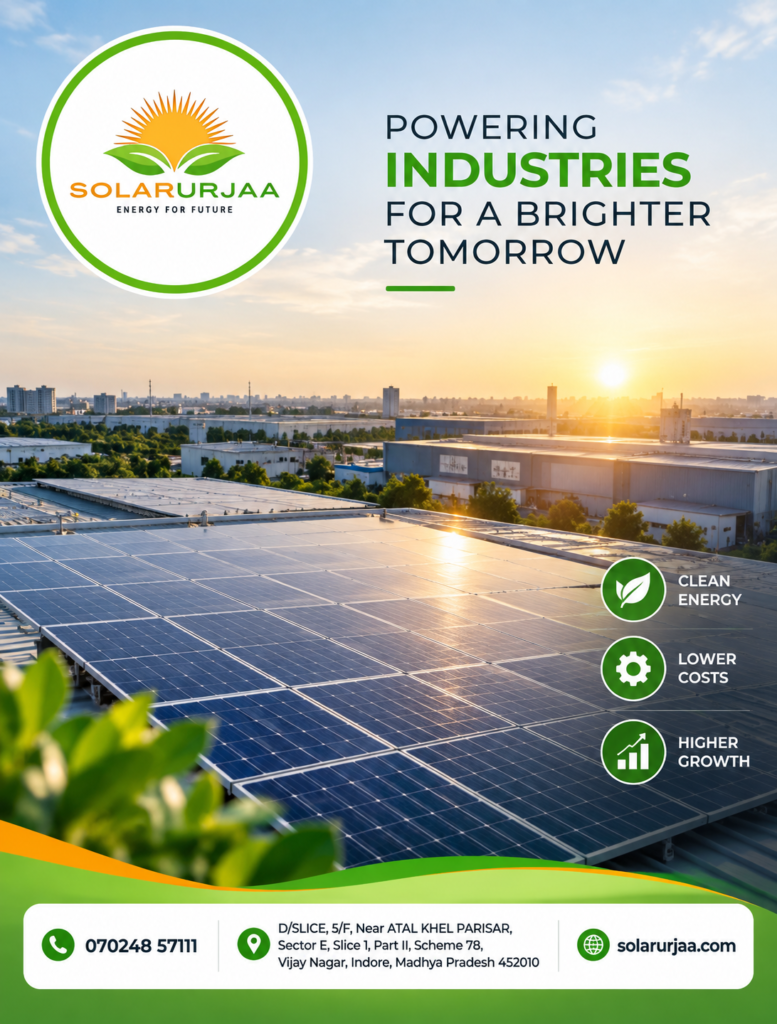
What Is Industrial Solar Installation?
Industrial solar installation involves designing and installing a solar photovoltaic (PV) system for factories, manufacturing plants, warehouses, industrial buildings and other high-energy-consumption facilities.
Unlike a small residential solar system, an industrial solar project is generally designed around:
- Electricity consumption
- Available rooftop or land area
- Daytime energy usage
- Electrical load
- Roof structure
- Solar irradiation
- Inverter configuration
- Grid connection
- Applicable regulations and DISCOM requirements
- Project budget and financial objectives
A professional solar installer first evaluates the facility and electricity consumption before recommending an appropriate system size.
SolarUrjaa states that its solar solutions cover homes, housing societies and commercial applications, and that its team provides site surveys, system designs, savings estimates and installation support.
Why Industrial Solar Installation in Indore Is a Smart Choice
For industries, electricity is often a recurring operational expense. Installing solar can convert part of that expense into a long-term energy asset.
Here are some of the major benefits.
1. Reduce Electricity Costs
One of the biggest reasons businesses consider solar is the potential to reduce electricity expenses.
When a solar system generates electricity during operating hours, that generation can offset electricity that would otherwise be purchased from the grid, subject to the project’s electrical configuration and applicable regulations.
For an industrial facility with substantial daytime consumption, this can make solar particularly attractive.
2. Improve Long-Term Energy Cost Predictability
Grid electricity prices and commercial or industrial tariffs can change over time.
A solar installation allows a business to generate a portion of its own electricity instead of purchasing all of its power from the grid.
This can provide greater predictability for long-term energy planning.
The actual savings depend on factors such as:
- Electricity tariff
- Solar system size
- Annual generation
- Self-consumption
- System performance
- Financing cost
- Applicable regulations
3. Make Better Use of Large Industrial Rooftops
Many factories and warehouses have large rooftop areas that remain unused.
Instead of treating the roof simply as part of the building, businesses can potentially use suitable roof space for solar generation.
A professional feasibility assessment should consider:
- Roof strength
- Available area
- Shading
- Orientation
- Roof condition
- Access for maintenance
- Electrical infrastructure
Structural and shadow assessments are important parts of commercial and industrial solar project planning.
4. Support Sustainability Goals
Solar energy can help businesses reduce their dependence on conventional electricity sources and lower the carbon intensity associated with their electricity consumption.
For companies working toward sustainability, ESG or environmental targets, an industrial solar project can become an important part of their renewable-energy strategy.
It can also strengthen a company’s commitment to cleaner energy and responsible resource utilization.
5. Low Routine Maintenance
Solar PV systems generally have relatively low routine maintenance requirements compared with many conventional power-generation systems.
Typical maintenance can include:
- Periodic panel cleaning
- Visual inspections
- Electrical checks
- Inverter monitoring
- Cable and connection inspections
- Preventive maintenance
SolarUrjaa says it provides quarterly cleaning, health checks and maintenance support as part of its stated service offering.
Industrial Solar Installation Cost in Indore
One of the most common questions businesses ask is:
“How much does industrial solar installation cost in Indore?”
There is no single price that applies to every industrial project.
The final project cost depends on the size and technical requirements of the installation.
Major factors affecting solar installation cost include:
- Solar system capacity
- Solar module technology
- Inverter selection
- Mounting structure
- Roof type
- Roof height and accessibility
- DC and AC cabling
- Electrical protection equipment
- Transformer requirements
- Civil work
- Installation complexity
- Monitoring system
- Grid-interconnection requirements
- Operation and maintenance requirements
For this reason, businesses should avoid selecting an installer solely on the lowest quoted per-kW price.
A proper site survey and technical proposal provide a more meaningful estimate.
How Is Solar ROI Calculated for an Industrial Project?
Return on Investment (ROI) is one of the most important factors when evaluating an industrial solar project.
A simplified calculation can be represented as:
Annual Solar Savings = Annual Solar Generation × Effective Value of Solar Energy
And:
Simple Payback Period = Total Project Investment ÷ Annual Savings
For example, if an industrial solar system costs ₹50 lakh and generates ₹12.5 lakh worth of annual electricity savings, the simple payback would be approximately:
₹50 lakh ÷ ₹12.5 lakh = 4 years
This is only an illustrative calculation. Actual industrial solar ROI can vary significantly based on electricity tariffs, system generation, self-consumption, financing, taxes, maintenance and applicable regulations.
Current commercial solar guidance also emphasizes that project economics depend on factors such as system size, inverter configuration, mounting structure, electrical scope, tariff and daytime consumption.
What Factors Affect Industrial Solar ROI?
Before investing in solar, businesses should evaluate the following factors.
1. Electricity Tariff
The higher the effective cost of grid electricity being displaced, the greater the potential value of solar generation.
2. Solar Generation
System orientation, shading, module efficiency, weather conditions and system design influence annual generation.
3. Daytime Consumption
Industrial facilities operating mainly during daylight hours may be well positioned for self-consumption because solar generation can align with operating hours.
4. System Size
Installing the right-sized system is critical.
An oversized system may not provide the expected economics if there is insufficient consumption or an unfavorable export arrangement.
5. Financing
Whether the project is funded through company capital, a loan, lease or another financing model can significantly affect cash flow and payback.
6. Operations and Maintenance
Regular cleaning, monitoring and preventive maintenance help maintain system performance over time.
Types of Industrial Solar Systems
Industrial businesses can consider different solar configurations depending on their site and energy requirements.
Rooftop Solar
Rooftop solar is suitable for factories, warehouses and industrial buildings with adequate roof area.
Advantages can include:
- Uses existing roof space
- Does not require additional land
- Can generate power close to the point of consumption
- Suitable for many commercial and industrial facilities
Ground-Mounted Solar
Ground-mounted solar can be considered when sufficient land is available.
It may be suitable for larger industrial facilities or businesses with limited usable rooftop space.
Grid-Connected Solar
A grid-connected system operates alongside the existing electricity grid.
This can allow businesses to use solar generation when available while retaining grid electricity as part of their overall power arrangement.
The exact metering and export arrangements depend on the connection category and applicable regulations.
Solar With Battery Storage
Battery storage can be considered where a business has specific backup, peak-management or energy-management requirements.
However, adding batteries increases project cost, so the business case should be evaluated carefully.
Industrial Solar Installation Process in Indore
A professional industrial solar installation in Indore generally involves several stages.
Step 1: Electricity Bill Analysis
The installer reviews electricity bills and consumption patterns to understand the facility’s energy requirements.
Step 2: Site Survey
The team assesses the rooftop or available land, shading, structural conditions and accessibility.
Step 3: Solar System Design
Engineers determine the appropriate capacity, module layout, inverter configuration and electrical design.
Step 4: Financial Proposal
The business receives an estimate covering project investment, expected generation, potential savings and other applicable project costs.
Step 5: Installation
Solar modules, mounting structures, inverters, cables and required electrical equipment are installed.
Step 6: Testing and Commissioning
The system is tested to ensure proper electrical operation and safety.
Step 7: Grid Integration
Where applicable, required coordination and metering processes are completed with the relevant electricity distribution authorities.
Step 8: Monitoring and Maintenance
After commissioning, system performance can be monitored and periodic maintenance carried out to maintain reliable operation.
SolarUrjaa describes a process that includes site assessment, customized system design, savings estimation, installation, grid connection support and ongoing maintenance.
Who Can Benefit From Industrial Solar Installation?
Industrial solar can be considered by a wide range of businesses, including:
- Manufacturing units
- Factories
- Warehouses
- Food processing facilities
- Pharmaceutical facilities
- Textile units
- Engineering industries
- Commercial buildings
- Large offices
- Educational institutions
- Hospitals
- Industrial plants
The suitability of solar depends on the facility’s energy profile, available space and technical and regulatory conditions.
Why Choose SolarUrjaa for Solar Installation in Indore?
Solarurjaa Indore – Solar Panel Dealer in Indore is located in Scheme 78, Vijay Nagar, Indore.
According to SolarUrjaa’s website, the company provides solar solutions for homes, housing societies and commercial applications and offers services including site surveys, system design, savings estimates, installation support, grid connection assistance and maintenance.
SolarUrjaa also states that it has 15+ years of experience, has solarized 1,000+ homes, and has recorded ₹1 crore+ in savings for families across India from 2020–2025. These figures are company-stated claims.
For a business considering an industrial solar project, the best approach is to request a site assessment and customized proposal rather than relying on a generic price estimate.
Get a Solar Consultation in Indore
If your factory, warehouse or industrial facility has a high electricity bill, solar may be worth evaluating as a long-term energy investment.
SolarUrjaa – Indore
Address: D/SLICE, 5/F, Near Atal Khel Parisar, Sector E, Slice 1, Part II, Scheme 78, Vijay Nagar, Indore, Madhya Pradesh – 452010
Phone: 070248 57111
Website: SolarUrjaa
A professional site assessment can help determine the suitable system size, estimated generation, project cost and potential savings for your facility.
Frequently Asked Questions About Industrial Solar Installation in Indore
How much does industrial solar installation cost in Indore?
The cost varies according to system capacity, modules, inverters, mounting structures, electrical work, roof conditions, installation complexity and other project requirements. A site-specific quotation is more reliable than a standard per-kW estimate.
Is industrial solar profitable?
Industrial solar can provide attractive long-term economics when the system is correctly sized and a significant portion of its generation offsets relatively expensive grid electricity. Actual ROI depends on the project’s individual financial and technical conditions.
How long does an industrial solar system last?
Solar modules are designed for long-term operation, while other components such as inverters may have different service lives. Actual system life depends on equipment quality, environmental conditions, installation quality and maintenance.
Is rooftop solar suitable for factories?
Yes, suitable factory and warehouse rooftops can be used for solar installations, provided they have adequate structural strength, usable area, suitable orientation and appropriate electrical connectivity.
Can solar reduce industrial electricity bills?
Yes. Solar generation can offset electricity purchased from the grid, potentially reducing energy costs. The actual reduction depends on the system’s generation, the facility’s consumption pattern and applicable electricity regulations.
How do I choose an industrial solar installer in Indore?
Look for an installer that can provide proper site assessment, engineering design, transparent costing, quality equipment, installation expertise, documentation support, monitoring and after-sales maintenance.
Conclusion
Industrial solar installation in Indore can be a strategic investment for businesses looking to manage electricity expenses, improve energy cost predictability and adopt cleaner energy.
However, the success of a solar project depends on more than simply installing panels. Proper system sizing, structural assessment, electrical design, equipment selection, installation quality, monitoring and maintenance all contribute to long-term performance.
If you are considering solar for a factory, warehouse or industrial facility, start with your electricity bills and a professional site assessment. From there, you can compare the expected generation, investment, savings and ROI before making an informed decision.
For businesses in Indore looking to explore solar solutions, SolarUrjaa can be contacted for a consultation and project assessment.