
The demand for solar energy in India is growing rapidly as homeowners, businesses, industries, and institutions look for ways to reduce electricity expenses and use clean energy. But before installing a solar system, one of the most important questions is: What is the solar system cost in India?
The answer depends on several factors, including the size of the solar system, type of solar panels, inverter technology, mounting structure, installation requirements, battery capacity, location, electrical work, and applicable government subsidy.
A solar system is also much more than just a set of solar panels. A properly installed system includes several electrical and structural components that work together to convert sunlight into usable electricity safely and efficiently.
This guide explains solar system prices in India, government subsidy, what is included in a complete solar system, different system types, installation costs, maintenance, expected savings, and important points to check before purchasing.
What Is the Solar System Cost in India?
There is no single fixed price for every solar installation. The final price depends on the system capacity and the components selected.
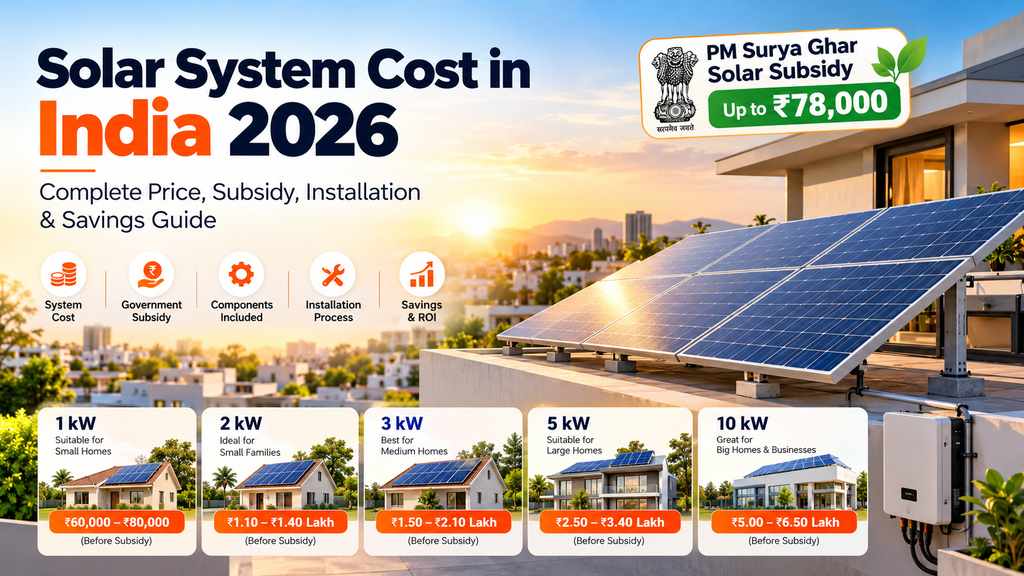
For residential rooftop solar, the following can be used as an indicative planning range:
| Solar System Size | Approx. Cost Before Subsidy | Maximum Central Subsidy* |
|---|---|---|
| 1 kW | ₹60,000 – ₹80,000 | ₹30,000 |
| 2 kW | ₹1.10 – ₹1.40 lakh | ₹60,000 |
| 3 kW | ₹1.50 – ₹2.10 lakh | ₹78,000 |
| 5 kW | ₹2.50 – ₹3.40 lakh | ₹78,000 |
| 10 kW | ₹5.00 – ₹6.50 lakh | ₹78,000 |
These are indicative market ranges, not government-fixed retail prices. Actual quotations can vary according to panel and inverter brands, system design, roof structure, installation complexity, electrical work, location, warranty and other specifications.
Important: The maximum central residential subsidy under PM-Surya Ghar does not continue increasing after 3 kW. The applicable central CFA is ₹30,000/kW for the first 2 kW and ₹18,000 for the additional 1 kW, with no additional central CFA beyond 3 kW.
PM Surya Ghar Solar Subsidy in India
One of the biggest advantages for eligible residential consumers is the PM-Surya Ghar: Muft Bijli Yojana.
The current central financial assistance structure for eligible residential rooftop solar is:
- First 2 kW: ₹30,000 per kW
- Additional 1 kW: ₹18,000
- Beyond 3 kW: No additional central CFA
- Maximum central subsidy: ₹78,000
For example:
1 kW Solar System
Subsidy calculation:
1 × ₹30,000 = ₹30,000
Maximum central subsidy: ₹30,000
2 kW Solar System
Subsidy calculation:
2 × ₹30,000 = ₹60,000
Maximum central subsidy: ₹60,000
3 kW Solar System
Subsidy calculation:
2 × ₹30,000 + 1 × ₹18,000 = ₹78,000
Maximum central subsidy: ₹78,000
5 kW Solar System
The first 2 kW receives ₹60,000 and the additional 1 kW receives ₹18,000.
Therefore:
Maximum central subsidy = ₹78,000
The additional capacity beyond 3 kW does not receive additional central CFA under this structure.
The government scheme is implemented through the National Portal, and MNRE states that eligible consumers pay the balance amount after deduction of the applicable subsidy/CFA to an empanelled vendor following successful installation and verification through the applicable process.
Always check the current scheme rules, eligibility and DISCOM requirements before making a purchase because subsidy procedures and applicable conditions can change.
What Is Included in a Solar System?
When someone asks for the solar system cost in India, it is important to understand what the quotation actually includes.
A complete rooftop solar installation generally consists of multiple components.
1. Solar Panels
Solar panels are the primary electricity-generating component.
They capture sunlight and convert solar energy into DC electricity.
The price of panels depends on factors such as:
- Panel technology
- Efficiency
- Rated power
- Manufacturer
- Warranty
- Electrical specifications
- Applicable quality and eligibility requirements
A quotation should clearly mention the panel make, model, wattage and quantity.
2. Solar Inverter
The electricity generated by solar panels is DC electricity. Most household appliances operate on AC electricity.
The solar inverter converts DC electricity generated by the panels into usable AC electricity.
Depending on the system, you may encounter:
- On-grid inverter
- Off-grid inverter
- Hybrid inverter
- String inverter
- Other inverter configurations
The inverter is a critical part of the system, so customers should compare efficiency, capacity, warranty, monitoring features and compatibility rather than choosing purely on price.
3. Mounting Structure
Solar panels need to be securely mounted on the roof.
A mounting structure generally includes:
- Rails
- Frames
- Clamps
- Fasteners
- Supporting members
- Required foundation or anchoring components
The structure must be suitable for the roof and local environmental conditions.
The cost can vary depending on whether the installation is on an RCC roof, metal roof, elevated structure or another type of surface.
4. DC Cables
DC cables connect the solar panels to the inverter.
Properly rated solar cables are important for safe and efficient power transmission.
Cable length can also affect the total project cost, particularly where the panels and inverter are located far apart.
5. AC Cables
AC cables carry electricity from the inverter toward the property’s electrical system.
The required cable size depends on the system design and electrical specifications.
6. DCDB – DC Distribution Box
A DC distribution box provides protection on the DC side of the solar installation.
Depending on system design, it can contain protective devices such as:
- DC isolator
- Surge protection device
- Fuses or other protective equipment
The exact configuration depends on the system.
7. ACDB – AC Distribution Box
The ACDB provides protection between the inverter and the AC electrical network.
It may include:
- AC isolator
- Surge protection
- Circuit protection
- Other required electrical safety components
8. Earthing
Proper earthing is an important safety consideration.
A solar installation may require appropriate earthing arrangements for equipment and electrical protection according to the applicable standards and system design.
Customers should ask the installer whether earthing work is included in the quotation.
9. Lightning Protection
Depending on the site, system design and applicable requirements, lightning protection may be recommended or required.
Customers should ask whether lightning protection is included or quoted separately.
10. Net Metering Equipment and Process
For an eligible grid-connected rooftop solar system, the installation may involve the applicable net-metering process with the local electricity distribution company.
Net metering allows the electricity generated by the rooftop system to interact with the grid according to the applicable regulations and approved arrangement.
The exact process, equipment and charges can vary by state and DISCOM.
11. Installation and Commissioning
A complete quotation may also include professional installation.
Installation can involve:
- Site preparation
- Mounting structure installation
- Solar panel installation
- Inverter installation
- DC wiring
- AC wiring
- Protection equipment
- Earthing
- Testing
- Commissioning
Customers should confirm in writing exactly what installation services are included.
12. Monitoring System
Many modern solar inverters provide digital monitoring.
Depending on the inverter, customers may be able to monitor:
- Daily generation
- Monthly generation
- System performance
- Inverter status
- Fault notifications
- Historical generation
Monitoring can help identify performance problems early.
What May NOT Be Included in a Solar Quotation?
This is an important question that many buyers overlook.
A quotation that appears cheaper may not include certain expenses.
Depending on the vendor, the following may be excluded or charged separately:
- Major roof repair
- Structural reinforcement
- Long-distance cable installation
- Additional civil work
- Elevated mounting structures
- Battery storage
- Additional electrical panels
- Transformer-related work
- Special access equipment
- Additional earthing work
- Lightning protection
- Government or DISCOM-related charges where applicable
- Electrical load enhancement
- Other site-specific work
Therefore, never compare solar quotations only on the final number.
Ask for a detailed component-wise quotation.
On-Grid Solar System Cost in India
An on-grid solar system is connected to the electricity grid.
It is generally one of the most economical options for properties that already have reliable grid electricity.
A typical on-grid system includes:
Solar Panels → DC Protection → Solar Inverter → AC Protection → House Electrical System → Grid
Advantages
- Lower initial cost than battery-based systems
- No large battery bank required
- Suitable for reducing grid electricity consumption
- Can work with applicable net-metering arrangements
- Lower battery maintenance requirements
For many urban homeowners, an on-grid system is the first option worth evaluating.
Off-Grid Solar System Cost
An off-grid solar system operates independently of the electricity grid.
Because it needs energy storage, the system generally includes batteries.
A typical configuration is:
Solar Panels → Charge/Inverter System → Battery → Electrical Loads
The cost can be significantly higher than a basic on-grid installation because of battery storage.
Off-grid systems can be useful in locations where grid electricity is unavailable or unreliable.
Hybrid Solar System Cost
A hybrid solar system combines solar generation, grid connectivity and battery storage.
It can provide both solar savings and backup power.
A hybrid system can be attractive for customers who experience frequent power cuts or want greater energy independence.
However, batteries increase the initial investment.
Battery capacity should be selected according to the appliances that need backup and the desired backup duration.
How Much Roof Space Is Required?
The required rooftop area depends on:
- Solar panel wattage
- Panel dimensions
- Number of panels
- Mounting arrangement
- Roof shape
- Required maintenance access
- Shading
A larger system naturally requires more space.
For example, a 5kW system requires considerably more rooftop area than a 1kW system.
A professional site survey is therefore recommended before finalizing system capacity.
How to Decide the Right Solar System Size?
Do not select a solar system simply because a particular size is popular.
Start with your electricity consumption.
Review your electricity bills and consider:
- Monthly units consumed
- Seasonal electricity usage
- Daytime electricity consumption
- Future electricity requirements
- Available roof space
- Budget
- Backup requirements
A professional solar installer can then recommend an appropriate capacity.
Solar System Cost vs Long-Term Savings
The initial solar investment should be evaluated against long-term electricity savings.
A simplified calculation is:
Payback Period = Net Solar Investment ÷ Annual Electricity Savings
For example, if your net investment after applicable subsidy is ₹1,00,000 and your estimated annual electricity savings are ₹25,000:
₹1,00,000 ÷ ₹25,000 = 4 years
This is only an illustration. Actual payback depends on electricity tariffs, solar generation, self-consumption, system performance, maintenance, financing and applicable electricity regulations.
How Much Electricity Can a Solar System Generate?
Solar generation varies according to:
- Location
- Sunlight availability
- Panel orientation
- Tilt angle
- Shading
- Panel efficiency
- Weather
- System losses
- Cleaning and maintenance
Therefore, a 3kW system will not necessarily generate exactly the same amount of electricity every day.
Solar production is generally higher during strong sunlight and lower during cloudy or rainy conditions.
A professional installer should provide an estimated generation figure based on the specific site.
Solar Panel Warranty vs Solar System Warranty
Another important point is that a solar system consists of multiple components, and each component can have its own warranty.
Ask about:
Solar Panel Warranty
Check the product and performance warranty offered for the specific panel model.
Inverter Warranty
Check the standard warranty period and whether extended warranty options are available.
Mounting Structure
Ask about material quality and warranty coverage.
Installation Warranty
Confirm whether the installer provides workmanship or installation support.
After-Sales Service
Ask who will handle troubleshooting, replacement and service requests.
How to Compare Two Solar Quotations
Suppose one company quotes ₹1.50 lakh and another quotes ₹1.35 lakh.
The cheaper quotation is not automatically better.
Compare:
| Factor | What to Check |
|---|---|
| Solar Panels | Brand, model, wattage and technology |
| Inverter | Capacity, efficiency and warranty |
| Structure | Material and design |
| Cables | Quality and specifications |
| Protection | DCDB, ACDB, SPD and isolators |
| Earthing | Included or additional |
| Installation | Complete or partial |
| Net Metering | Assistance/process included? |
| Monitoring | App or monitoring system |
| Warranty | Product and service coverage |
| After-Sales | Service availability |
| Subsidy | Eligibility and process |
| Final Cost | Complete installed price |
This approach gives you a much more meaningful comparison.
Is Solar System Installation Worth It in India?
For many homeowners and businesses, solar can be a strong long-term energy investment.
The benefits can include:
Lower Electricity Expenses
Solar generation can reduce the amount of electricity purchased from the grid.
Renewable Energy
Solar produces electricity without directly burning fossil fuels at the point of generation.
Long-Term Investment
A properly designed and maintained solar system can provide energy generation for many years.
Reduced Grid Dependence
Generating electricity on-site can reduce dependence on conventional grid power.
Potential Government Support
Eligible residential consumers can benefit from the applicable PM-Surya Ghar central financial assistance.
Common Mistakes to Avoid When Buying Solar
1. Choosing Only on Price
The lowest quotation may not provide the best long-term value.
2. Ignoring the Inverter
A good solar panel paired with an unsuitable inverter can affect overall system performance.
3. Not Checking the Complete BOQ
Always request a detailed bill of quantities or component list.
4. Ignoring Roof Shading
Even partial shading can affect solar generation.
5. Not Asking About Warranty
Understand exactly what is covered.
6. Assuming Every System Gets the Same Subsidy
Subsidy depends on eligibility and applicable government rules.
7. Not Checking the Installer
For government-supported residential installations, verify the vendor and process through the official portal and relevant DISCOM.
Frequently Asked Questions
What is the cost of a 1kW solar system in India?
A residential 1kW system may cost approximately ₹60,000–₹80,000 before subsidy, depending on components and installation. Eligible consumers may receive up to ₹30,000 central subsidy.
What is the cost of a 3kW solar system in India?
A 3kW residential system may cost approximately ₹1.50–₹2.10 lakh before subsidy. The maximum central subsidy under the current PM-Surya Ghar structure is ₹78,000 for eligible residential consumers.
What is the subsidy on a 5kW solar system?
The maximum central residential CFA remains ₹78,000. There is no additional central CFA for capacity beyond 3kW under the stated structure.
Does solar installation include batteries?
Not always. A standard on-grid solar system generally does not include battery storage. Batteries are normally required for off-grid systems and can be added to hybrid systems.
Does a solar system include installation?
Many complete quotations include installation, but the exact scope varies by vendor. Always confirm whether structure installation, wiring, earthing, protection equipment, commissioning and other work are included.
Does solar completely eliminate the electricity bill?
Not necessarily. Your bill depends on electricity consumption, generation, tariff, fixed charges, net-metering rules and other applicable charges.
Which solar system is best for a home?
For a home with reliable grid electricity, an on-grid system is often worth evaluating first. If backup power is important, a hybrid system may be more appropriate. The final choice depends on electricity consumption, budget and backup requirements.
Final Verdict: Understanding Solar System Cost in India
The solar system cost in India should never be judged only by the number printed on a quotation.
A complete solar investment includes panels, inverter, mounting structure, cables, protection equipment, earthing, installation, commissioning and potentially net-metering support and monitoring. Battery storage, civil work and other site-specific requirements can add to the total cost.
For eligible residential consumers, the PM-Surya Ghar scheme can substantially reduce the effective investment, with the current central subsidy structure providing ₹30,000/kW for the first 2kW and ₹18,000 for the additional 1kW, up to a maximum central CFA of ₹78,000.
The smartest approach is to compare complete system specifications, not just prices.
Before installation, get a site assessment, calculate your electricity consumption, select the appropriate system type, compare component quality and warranties, verify subsidy eligibility, and request a transparent quotation showing exactly what is included.
With the right system design and professional installation, solar can help households and businesses reduce their dependence on conventional electricity while making a long-term investment in clean energy.